
India's economy is not like Western ones, and thus needs restrained fiscal policy even during a recession, says Ajay Shah.

The principal challenge for Rajan's successor is to work with the Bank Board Bureau and the finance ministry to complete these processes of banking reform.

According to D&B, food price levels might witness a rebound as foodgrain production is estimated to have declined during 2014-15.

To cut interest rates, the central bank head has to open up a debate on inflation target revision.
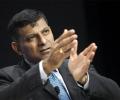
Rajan, as expected, furthered his predecessors' agenda and continued with the same resolution to make India's financial system safer, and direct the economy towards further liberalisation
'A strong foreign exchange reserve is the best safety net against global spillovers.'

Finance minister Arun Jaitley has delivered a Arun Jaitley delivered a bold, far sighted budget

The Reserve Bank is working on a phased implementation strategy for its own digital currency and is in the process of launching it in wholesale and retail segments in the near future, RBI Deputy Governor T Rabi Sankar said on Thursday. He said the idea of Central Bank Digital Currency (CBDC) is ripe, and many central banks in the world are working towards it. Sankar further said CBDC is needed to protect consumers from the "frightening level of volatility" seen in some of the virtual currencies which have no sovereign backing.
By no means do economists see the Reserve Bank of India stop at just a 25-bp cut. Some of the economists such as Soumyakanti Ghosh of State Bank of India are of the firm view that rates have room to fall by a total of 75 bps in the current financial year, starting with 25 bps in the August 7 policy.

The year 2014-15 could well go as one of long-pending financial sector reforms, expected to have a lasting impact.

Analysts at Bank of America Merill Lynch said that fears of inflation getting "generalised" are overdone, as only two sub-categories of fuel and light and housing (accounting for 22 per cent of the basket) have seen a price-rise above the headline 5.2 per cent.

Markets are assuming that by the second half of 2021, the world will be approaching some type of normalcy, points out Akash Prakash.

.jpg)
The central bank will come out with two measures on restructuring to tackle financial stress, Rajan said.

The change from wholesale to retail inflation as an anchor means that the weightage of diesel in inflation has decreased
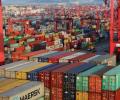
A healthy growth in India's services segments has helped the country's total exports and imports of goods and services to cross the $800 billion mark during the first half of 2023, despite a slowdown in global demand, think tank GTRI said in a report on Monday. According to the analysis of the Global Trade Research Initiative (GTRI), exports of goods and services rose by 1.5 per cent to $385.4 billion during January-June this year, as against $379.5 billion in January-June 2022. Imports, however, dipped by 5.9 per cent to $415.5 billion during the six months of this year, as against $441.7 billion in January-June 2022.
Reserve Bank of India on Thursday said a centralised portal would be ready in three to four months wherein depositors and beneficiaries can access details of unclaimed deposits across various banks. As of February this year, about Rs 35,000 crore of unclaimed deposits were transferred to RBI by public sector banks in respect of deposits which were not operated for 10 years or more. "In order to improve and widen the access of depositors/beneficiaries to such data, RBI has decided to develop a web portal to enable search across multiple banks for possible unclaimed deposits based on user inputs," RBI Governor Shaktikanta Das said while announcing the first bi-monthly monetary policy for the current financial year.
Given the pressure from India Inc and the banking fraternity, it is surmised that the portfolio rejig will take place before April.

Indian economy is expected to improve marginally in the current financial year with its GDP at market price projected to expand by 3.4 per cent from 3.3 per cent in the previous fiscal, think tank OECD said.
The Reserve Bank (RBI) resisted a 'raid' planned by some in the government to extract Rs 2-3 lakh crore from its balance sheet in 2018 to meet populist spending in run-up to general elections, Viral Acharya, who was deputy governor at RBI at that time, has written.

The 30-share Sensex jumped 729 points to end at 28,076 and the 50-share Nifty soared 217 points to end at 8,494.

He has had a productive first year at the RBI -- one which saw, also, India's economic imbalances improve and the unexpectedly strong general election outcome.

investors will look to the new governor to continue the banking sector clean-up with the same urgency as Mr Rajan, who was targeting fully cleaned-up and provisioned balance sheets by March 2017

Says GDP growth rate from 2014-15 to 2015-16 will be greater than that of 2014-15 from 2013-14

Soon after RBI announcing a much- awaited rate cut, Chief Economic Advisor Arvind Subramanian on Wednesday said that the global rating agencies should look at upgrading their stance on India's credit outlook. "Now we have a 50 basis points rate cut (in two tranches within two months) and I think that is good for the economy and all rate cuts benefits... If the outlook is looking good, the rating agencies should draw their lessons from that om improving the outlook," Subramanian told reporters. After presentation of Union Budget 2015-16 last week, global and domestic agencies had ruled out any immediate upgrade in India's sovereign ratings and had red-flagged the country's delayed fiscal consolidation roadmap and had also warned against any slippages from the "ambitious" disinvestment plan proposed in Budget. Subramanian said that the rate cut is consistent with the government's views in the last week's Economic Survey and thereafter in the Union Budget for the outlook on inflation and for the outlook on overall economy. "It (rate cut) shows that RBI and government are on the same page in terms of how we view the economy. It also means that Budget can be seen as conducive to non-inflationary growth," he added. On monetary policy framework agreement, Subramanian said that both Finance Ministry and RBI have shared concern about inflation. Recently, the Finance Ministry and the Reserve Bank agreed to 'inflation rate targeting' under which the apex bank will aim to lower retail inflation to below 6 per cent by January 2016.

Governments that did not respect the central bank's independence would sooner or later incur the wrath of financial markets, ignite economic fire, and come to rue the day they undermined the regulatory institution, Deputy Governor Viral Acharya warned.
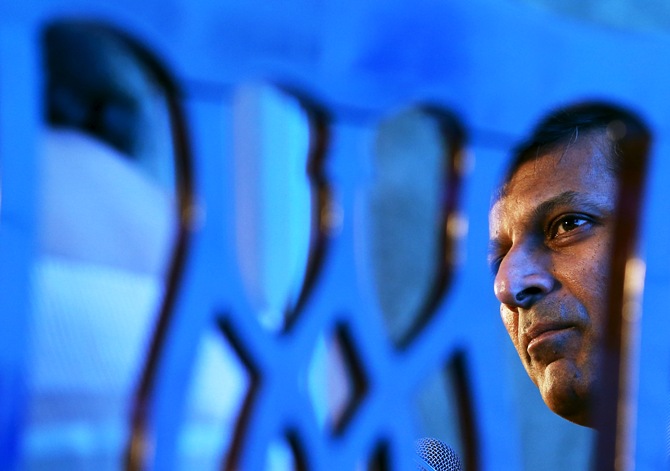
The RBI Governor brought down retail inflation to 3.8% in July.

Nitin Desai suggests some concrete measures to revive investment and boost growth.

Gita Gopinath, the IMF's Indian-American chief economist has been promoted as its First Deputy Managing Director recognising her exceptional intellectual leadership in helping the global economy and the Fund to navigate the "twists and turns" of the "worst economic crisis of our lives". Gopinath would replace Geoffrey Okamoto who plans to leave the International Monetary Fund early next year, Kristalina Georgieva, IMF's managing director announced on Thursday. Gopinath, who was scheduled to return to her academic position at Harvard University in January 2022, has decided to stay, she said. Gopinath, 49, has served as the first female chief economist of the Washington-based global lender for three years.

For the first time in 21 years, the Reserve Bank of India (RBI) will revise norms for investment portfolios of commercial banks to reflect changes in global standards on valuation and measurement, and progress in the domestic market. This could pave the way for banks to transition to the new accounting standards (Ind-AS). The outstanding investment portfolio of commercial banks was at Rs 45.84 trillion as of November 19 this year.
The idea is to boost household savings and turn more of them into growth capital. If the plan succeeds, sustained eight per cent-plus rates of gross domestic product growth should be within reach in a few years.

Pragmatism and flexibility is a virtue. An untethered and short-term approach to policymaking is a flaw, argues Mihir S Sharma.

Has Vijay Shekhar Sharma given up on the bank? For now, he seems to be on a save-OCL mission. The bank will face its logical end, observes Tamal Bandopadhyay.
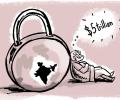
It would be a difficult task for the Indian economy to reach the $5-trillion mark a year before the International Monetary Fund (IMF) projection of 2026-27. Pankaj Chaudhary, minister of state for finance, said in the Rajya Sabha on Tuesday that the government is taking steps to make the country a $5-trillion economy at a date earlier than the IMF's projection. In that context, it would not be difficult to meet the projection in the third quarter of FY27.

Foreign portfolio investors (FPIs) remained net buyers to the tune of Rs 12,266 crore in the Indian market in the first five trading sessions of February, as positive sentiment post-Union Budget 2021 sparked a rally in investment.

India's near-term growth has improved: IMF

Moody's listed six agenda on the list of pending reforms -- land acquisition Bill, labour law reforms, significant infrastructure investment, tangible benefit from Make in India initiative, tax administration and PSU bank reforms

Reserve Bank Governor Raghuram Rajan on Thursday said the central bank will continue its focus on taming inflation, speeding up resolution of distressed projects and ensuring enough capital for banks through balance sheet clean-up.

IMF attributes the slower growth rate to supply-side bottlenecks.

Prime Minister Narendra Modi on Saturday announced the adoption of the New Delhi Leaders Declaration, a significant victory for India's G20 presidency that came amid increasing tensions and divergent views over the Ukraine conflict.
 © 2026 Rediff.com - Advertise with us - Disclaimer - Privacy Policy - Sitemap - Feedback - About us - Terms of use - Grievances